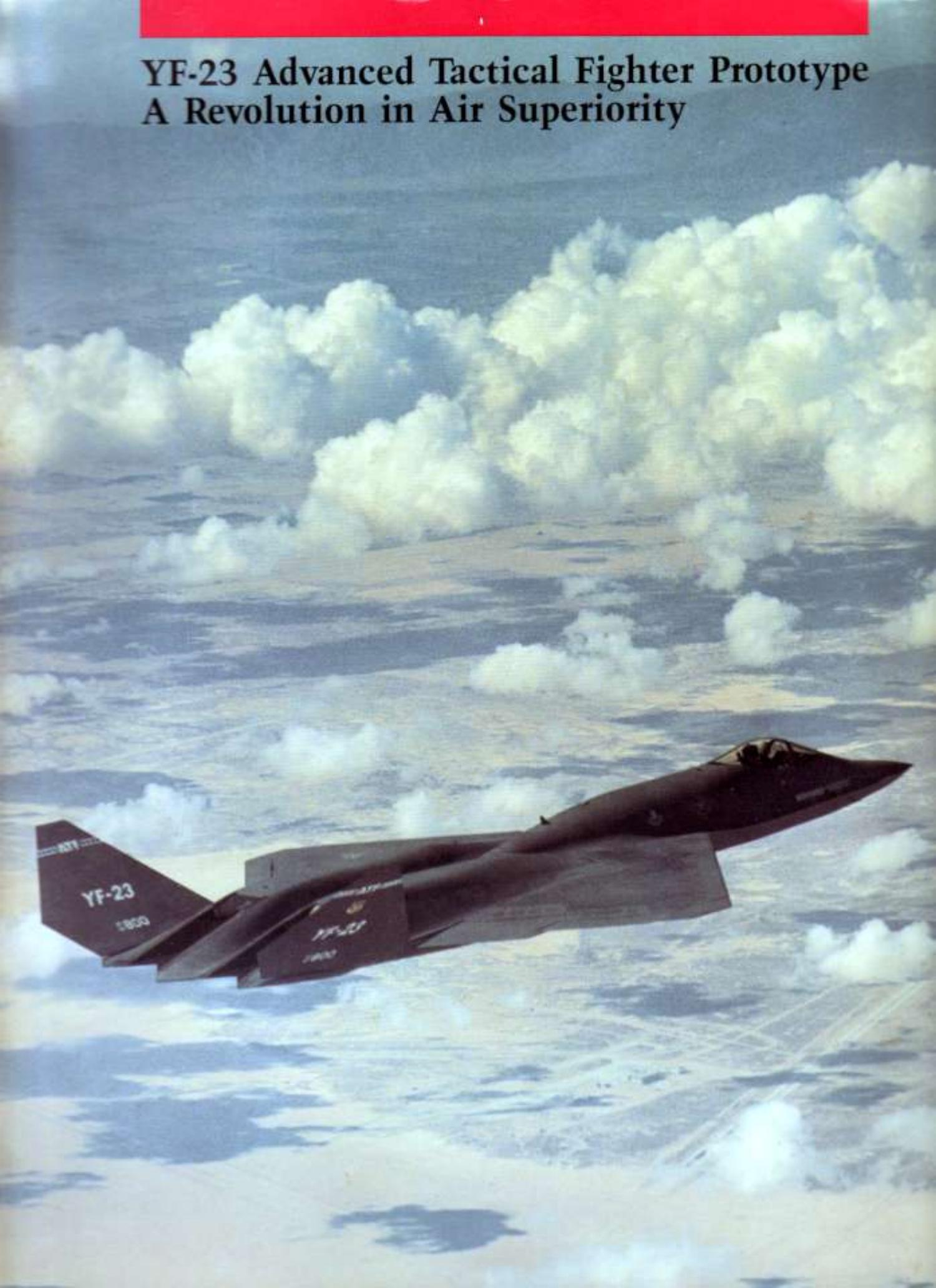
Yf 23 Plane - The Northrop/McDonnell Douglas YF-23 is a proposed fifth-generation North American fighter designed as a twin-engine stealth fighter for the United States Air Force (USF). Its design was one of the winners of the Advanced Tactical Fighter (ATF) competition, competing with the Lockheed YF-22 for the production contract. Two prototypes were developed, called "Black Widow II" and "Grey Phantom".
In the 1980s, the USAF held a tender for an aircraft that could replace its fighters, largely due to the advent of two advanced Soviet aircraft, the Sukhoi Su-27 and the Mikoyan MiG-29. . Several builders submitted project proposals; The USAF selected the Northrop and Lockheed proposals. Northrop partnered with McDonnell Douglas to develop the YF-23, while Lockheed, Boeing, and General Dynamics developed the YF-22.
Yf 23 Plane
Although the YF-23 was faster and stealthier, it was less agile than its Soviet counterparts. After four years of development and evaluation, the YF-22 was awarded the winning bid in 1991 and entered production as the Lockheed Martin F-22 Raor. The US Navy wanted to use the ATF tender to replace the aging F-14 Tomcat, but those plans were scrapped.
The Yf 23 Couldn't Beat The F 22 Raptor For This One Reason
US reconnaissance satellites first detected the Su-27 and MiG-29 in 1978, alarming the US. Both Soviet aircraft exceeded the American homologation in maneuverability.
In 1981, the USAF approached several aerospace companies for a feasibility (ATF) program to develop a replacement for the F-15 Eagle. After several discussions with these companies, the USAF set as the goal of this program the development of aircraft whose primary mission would be air-to-air combat.
The ATF uses advanced emerging technologies, including composite materials, mixtures of metals and elements, advanced flight control systems, more powerful propulsion vehicles, and most importantly, new stealth technologies. In October 1985, the USAF issued a request for proposals to several aircraft manufacturers. The specifications for this order were modified in May 1986 to include the evaluation of two prototype finalists. Meanwhile, the US Navy has announced that under the Navalized Advanced Tactical Fighter (NAFT) program, if the Air Force uses a finalist in the competition, another finalist will be used to replace the Navy's F-14 Tomcats. The NAFT program planned to purchase 546 aircraft, and the USAF program planned to purchase 750 aircraft.
A top view of the YF-23, where you can see the wing geometry and the space between the forward fuselage and the engine.
Us Navy F 45s On Patrol Over The Taiwan Strait By Indowflavour On Deviantart
In July 1986, Lockheed, Boeing, General Dynamics, McDonnell Douglas, Northrop, Grumman and Rockwell submitted their proposals. Grumman and Rockwell withdrew from the bidding soon after.
After the proposal was submitted, Lockheed, Boeing and General Dynamics formed a team to develop the proposal, three of which were selected. Northrop and McDonnell Douglas formed a similar team.
Finally, on October 31, 1986, the Lockheed and Northrop bids were selected. Both teams were given 50 months to build and test their prototypes; construction and testing were successful, resulting in the Lockheed YF-22 and Northrop YF-23.

Drawing on the valuable experience of the Northrop B-2 Spirit and F/A-18 Hornet, the YF-23 is less likely to be detected by enemy radar or infrared.
How Good Was The Yf 23? More Stealthier And Beautiful Than F 22 Raptor
The USAF initially required the aircraft to land and come to a full stop at less than 2,000 feet, which required reverse on the engines. In 1987, the USAF extended the landing distance limit to 914 meters, which eliminated reverse strikes. This meant that the aircraft could have an engine in a smaller footprint, but the external design remained the same.
The first YF-23 (serial number 87-0800), Prototype Air Transport 1 (PAV-1) was flown on 22 June 1990;
Another YF-23 (serial number 87-0801, PAV-2) made its maiden flight on October 26, piloted by Jim Sandberg.
The first YF-23 was painted charcoal black and nicknamed the "Spider".
Buy Northrop Yf 23 Atf
And "Black Widow II", referring to the World War II Northrop P-61 Black Widow. For a time this first prototype had a red hourglass marking on the fuselage similar to the black widows marking, but Northrop removed this marking.
Front view of YF-23 no. 87-0801 refers to the curvature of the aircraft's V-shaped stabilizer design.
The YF-23 was an unconventional-looking aircraft with diamond-shaped wings, thin fairings to minimize drag at high speeds, and V-shaped stabilizers. The pilot had good visibility. The landing gear was located on a tricycle, and the armament compartment was located under the fuselage, between the nose and the landing gear.

Two engines in separate compartments powered the aircraft; the air intake for the engines was a serpentine intake to reduce the chance of detection by radar waves.
File:yf 23 In The Restoration Area Of The Usaf Museum.jpg
The first prototype, the PAV-1, was powered by two Pratt & Whitney YF119 engines, while the PAV-2 was powered by two General Electric YF120 engines. The YF-22 engines had directional nozzles on the engines, while the YF-23 had fixed nozzles.
As in the B-2, the engine exhaust was released through a smoke system with heat spreaders, which enabled the aircraft to avoid infrared detection of enemy missiles.
Flight control systems are controlled by a central computerized system. Stabilizers are placed at an angle of 50 degrees. Tester Paul Metz said the YF-23 was able to achieve a higher angle of attack than any fighter jet up to that time.
By deploying the flaps in one direction and the ailerons in the opposite direction, the aircraft entered an aerodynamic deceleration position.
Yf 23 Archives
Despite its unconventional and innovative design, the builders tried to keep costs as low as possible, and this included components from other aircraft, such as the front landing gear of the F-15, the main landing gear of the F/A-18 achieved by using as and F-15 Strike Eagle flight deck components.
The first YF-23 with Pratt & Whitney engines reached Mach 1.43 on September 18, 1990, and the second with General Electric engines reached Mach 1.6 on November 29, 1990. By comparison, the YF-22 achieved supercruise Mach. 1.58.
The YF-23 was tested at a maximum speed of Mach 1.8 and was able to achieve a maximum angle of attack of 25 degrees.
Maximum speed is confidential, although sources claim top speed is greater than Mach 2 and supercruise is greater than Mach 1.6.
Yf 23 Hi Res Stock Photography And Images
Bomb, weapons, and missile units were formed for use, although they never fired any type of missile; Lockheed successfully launched the AIM-9 Sidewinder and AIM-120 AMRAAM missiles from its YF-22. On November 30, 1990, the PAV-1 conducted a combat demonstration consisting of six flights totaling 10 hours; tests continued until December.
In December 1990, both teams presented the results of their evaluations along with their proposals.
And on April 23, 1991, the Department of the Air Force announced that the Donald Rice YF-22 was the winner of the competition.
That's why the Air Force chose the YF119 engine to power the F-22. The designs achieved by Lockheed and Pratt & Whitney ranked higher in technical aspects, lower in terms of risk, and the aircraft control program was still considered more effective.
Northrop Yf 23 Black Widow
At the end of the contest, both YF-23s were flown to Edwards Air Force Base in California without their engines.
NASA wanted to use one of these aircraft to study methods for calibrating assumed payloads to measure flight performance, but this was never done.
In late 2004, Northrop proposed a bomber based on the YF-23 to meet the USAF's need for a new bomber, for which the FB-22 and B-1R were also competing.

The possibility of converting the YF-23 into a bomber was canceled in 2006 by the decision of the Quadrennial Defense Review, which approved the long-range bomber. The most popular concept so far is Lockheed Martin's proposal to create a hybrid of the F-22 Raptor, the world's best air combat platform, and the new F-35 Lightning II. However, some commentators believe that the F-3 program could see a resurrection of its own for the F-22.
Yf 23 Black Widow Ii Addon
Yf-23, yf 23 rc, yf 23 cost, 1 72 yf 23, yf-23 black widow, yf-23 model, 1 48 yf 23, yf 23 fighter, yf 23, yf 23 rc plane, yf 23 model kit, yf 23 aircraft
